
Manuscript Preparation
These guidelines help authors prepare manuscripts in a consistent format for efficient peer review, editing, and production. Authors are requested to follow these instructions carefully before submitting their manuscript.
Manuscript Language
Manuscripts must be written in clear, concise English.
Authors may use either British or American spelling, but it must be consistent throughout the manuscript.
Avoid overly complex sentences and unnecessary jargon.
File Format
- Microsoft Word (.doc or .docx) format
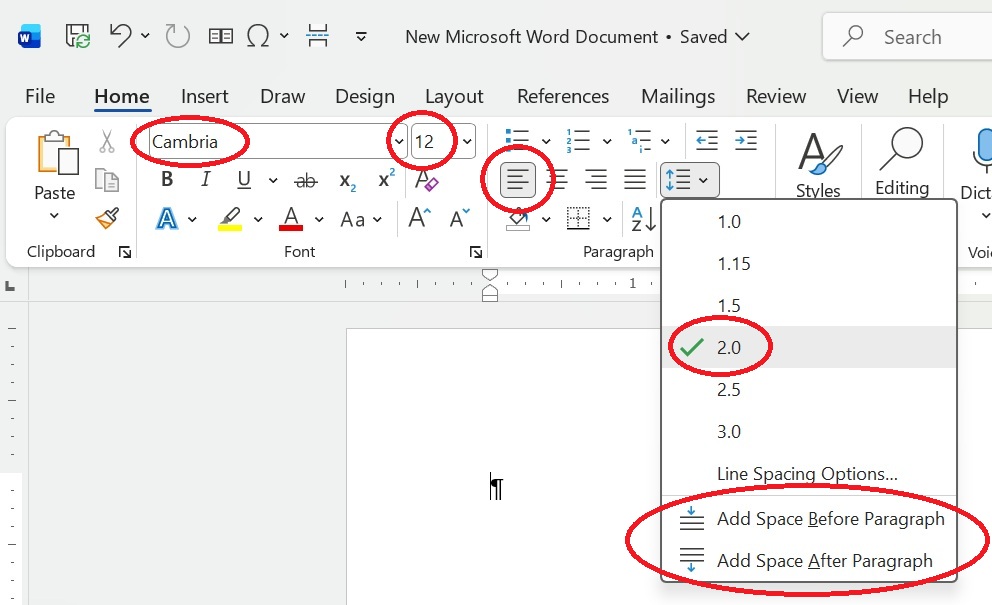
- Standard fonts such as Cambria/ Times New Roman
- Font size 12
- Double line spacing
- No space after or before paragraph
- Keep text left aligned
- Page numbers must be included at the bottom
Each chapter should normally be submitted as a separate file unless otherwise instructed by the book editor.
Structure of a Chapter
Each chapter should typically contain the following components:
1. Chapter Title
2. Author Information
- Full name
- Institutional affiliation
- City and country
- Email address (optional depending on book policy)
3. Abstract
- Abstract must be 150–250 words, summarizing the chapter.
4. Keywords
- 4–6 keywords relevant to the chapter topic.
5. Main Text
The authors shall use their creative liberty for selecting the headings of the main text, unless instructed by the book editor to follow pre-determined headings. A typical structure, though, usually starts with an introduction and end with conclusions.
6. Acknowledgements (optional)
Authors may acknowledge those who helped them in this scholarly work by giving their inputs, providing an image or perhaps critically reviewing your manuscript but their contribution is not sufficient to justify authorship.
7. References
The references shall follow the standard format used by NLM/PubMed. Authors should:
- Ensure accuracy and completeness of all references.
- Use recent and relevant citations where appropriate.
- Maintain consistent formatting throughout the chapter.
- Reference management software may be used by the authors taking care that the final reference style shall match exactly as outlined in the instructions on this page.
A few reference styles are provided below and authors are requested to format the references as per styles given below:
Journal article
Authors (upto 6 followed by et al). Article title. Journal name in italics. Year;Volume:page numbers
Examples
Kendirci M. How to write a medical book chapter? Turk J Urol. 2013;39(Suppl 1):37-40.
Seki K, Sueyoshi K, Miyoshi Y, Nakamura Y, Ishihara T, Kondo Y, et al. Complement activation and lung injury in Japanese patients with COVID-19: a prospective observational study. Sci Rep. 2024;14:24895.
Book Chapter
Author A, Author B (Year) Chapter title. In: Editors names (Ed) Book title or name, edition. Publisher (Publisher country)
Examples
Tikka S, Kopra J, Heinäniemi M, López-Pernas S, Saqr M (2024). Introductory Statistics with R for Educational Researchers. In: Saqr M, López-Pernas S (Ed) Learning Analytics Methods and Tutorials. Springer (Cham, Switzerland).
In the above example, note the use of full stops, comma etc. besides the fact that some of the authors of this chapter are also the editors of this book which does not have an edition (hence edition number is not mentioned in the reference).
Kalarani IB, Veerabathiran R (2023). Diabetes and Neurological Disorder. In: Noor R (Ed) Advances in Diabetes Research and Management. Springer (Singapore).
Internet source
Title of source [Internet]. Place of publication. Publisher. URL or link (Last accessed on DD-Month-YYYY)
For additional reference styles, authors may consult established publisher guidelines such as those provided by Springer Nature (document link)
Figures and Tables
Tables may be inserted at the end of the manuscript after the references. Figure caption should also be provided at the end of the manuscript.
Figures must be submitted separately as high quality .jpg, .tiff or .png format images.
Figures
- Submit high-resolution images (minimum 300 dpi).
- Acceptable formats: JPEG, TIFF, PNG.
- Each figure must have:
- Figure number
- Caption
- Source (if adapted or reproduced from others’ works).
Tables
- Tables should be created using the Word table function (not images).
- Provide a clear title above the table.
Units, Symbols, and Abbreviations
Use SI units wherever possible. Define abbreviations at first use. Avoid excessive abbreviations.
Ethical Considerations
Authors must ensure:
- The manuscript is original and not previously published.
- Proper citation of all sources.
- Necessary permissions for copyrighted material (figures, tables, images).
- Compliance with research ethics and institutional guidelines.
Details are available in the Wilton Clarke Academic Publishing Publication Ethics Policy.
Permissions
If any material (figures, tables, images, or large text extracts) has been previously published, the author must obtain written permission from the copyright holder. Proof of permission must be submitted with the manuscript. The author(s) submitting a scholarly work for publishing with Wilton Clarke Academic Publishing shall be required to submit a written declaration that all such copyright material has been used after permission of the copyright holder and no previously published material has been used in the manuscript without such permissions.
Plagiarism Screening
All manuscripts are screened using a commercial plagiarism detection software licensed to Wilton Clarke Academic Publishing. Submissions with significant overlap or unethical reuse of text may be rejected or returned for revision.
Final Submission Checklist
Manuscripts should be submitted to the book editor (for edited books) or directly to the Wilton Clarke Academic Publishing office (for authored books). Before submission, ensure that:
✔ The manuscript follows Wilton Clarke Academic Publishing formatting guidelines
✔ All figures and tables are properly labeled
✔ References are complete and formatted consistently
✔ Permissions have been obtained where required
✔ All contributing authors are listed correctly
 Wilton Clarke Academic Publishing